Sliding glass doors are one of the hardest openings in a home to dress well. Curtains bunch awkwardly to one side. Vertical blinds rattle every time the door opens and rarely age gracefully.
Most homeowners try one of those two options first, then start looking for something sturdier once the fabric fades or the vanes stop tracking straight. That’s usually when the search for plantation shutters for sliding doors actually begins.
Plantation shutters for sliding doors solve both problems at once, but the buying process involves a few decisions that windows never require. This guide walks through each one before you commit.
Decision One: Confirm the Door Actually Needs a Shutter Solution
Not every sliding glass door benefits equally from shutters. High-traffic doors used daily by kids, pets, or guests tend to see the biggest improvement over blinds or drapes that wear out fast under constant handling.
Doors used less frequently, such as a formal dining slider or a rarely opened bedroom exit, still benefit but with less urgency. Knowing how often the door gets used helps set realistic expectations for wear and long-term value.
It also helps decide where to prioritize budget if you’re outfitting several sliding doors at once. The busiest door in the house is usually where the upgrade pays off fastest, both in daily comfort and in how long the treatment holds up over time.
Decision Two: Bypass or Bifold Configuration
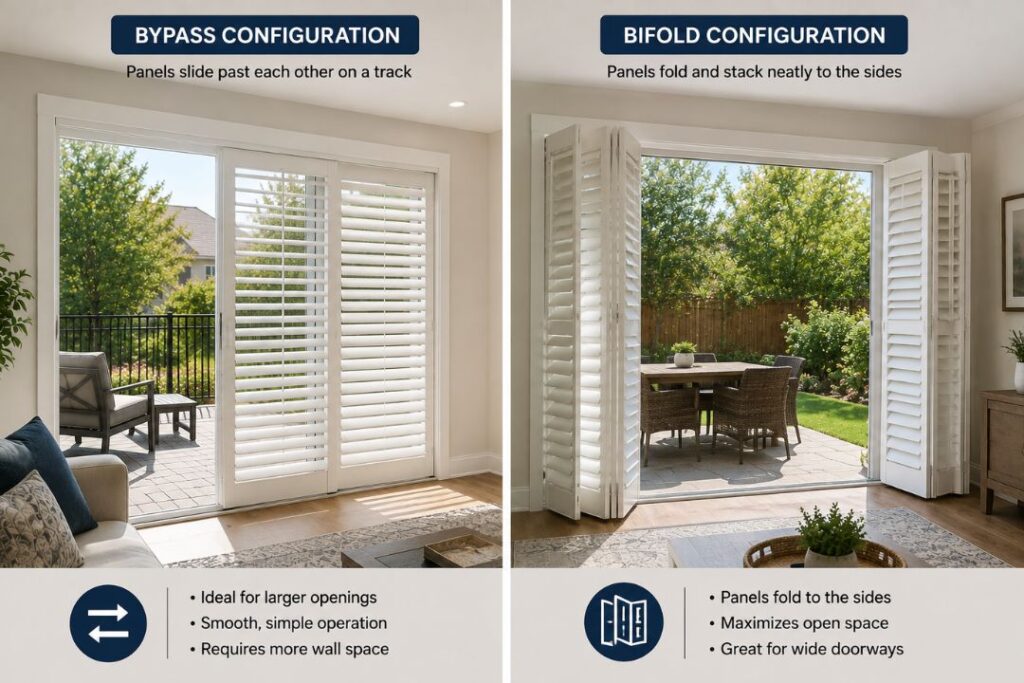
This is the single biggest choice specific to plantation shutters for sliding doors, since it determines how the panels move and how much space they need.
Bypass Panels
Bypass shutters ride on a track mounted above the door, sliding past each other the same way the glass itself does. They work well for wider openings and rooms where furniture sits close to the door, since nothing swings outward.
Bifold Panels
Bifold panels fold accordion-style and stack to one or both sides when opened. They allow full, unobstructed access to the doorway, which matters for doors used to move furniture or large items in and out.
Most Raleigh homeowners land on bypass for daily-use doors and bifold for doors where full clearance matters more than smooth gliding.
Neither configuration is objectively better than the other. The right choice depends entirely on how the room is furnished and whether anything ever needs to pass fully through that doorway, like moving a couch or wheeling out a grill for the season.
Decision Three: Inside Mount or Outside Mount
Standard sliding doors typically allow an inside mount, where the shutter frame sits within the door opening for a clean, built-in look. Some newer impact-rated glass doors are thick enough that an outside mount, extending slightly beyond the frame, becomes necessary instead.
This detail matters more than it sounds. Getting it wrong after measurements are taken often means reordering panels, so it’s worth confirming during the initial consultation rather than assuming based on the window treatments elsewhere in the home.
Decision Four: Material and Louver Size
Composite and PVC shutters resist humidity and temperature swings better than solid wood, which matters for sliding doors that sit exposed to direct sun for hours at a time. Stain-grade wood remains an option where a natural wood look matters more than moisture resistance.
Louver size affects both the view through the shutter and how much light passes when closed. Wider louvers open up sightlines and feel more modern, while narrower louvers give tighter light control and a more traditional look.
Homeowners furnishing a sunroom or a heavily used slider often lean toward composite or PVC purely for durability, saving solid wood for lower-traffic doors where the material won’t face daily wear.
Decision Five: Color, Finish, and Hardware
Because sliding doors sit at eye level and see daily use, finish choice matters more here than on a standard window. Matching the shutter frame to existing trim keeps the room feeling cohesive rather than like an afterthought addition.
Hardware details, including the divider rail placement on larger bypass panels, also affect how the finished shutter reads visually once installed on the door. These are small decisions that are easy to overlook until the panels are already hanging on the track.
What Measuring Actually Involves
Sliding doors require more precise measuring than a standard window because the panels need to glide cleanly without catching on the track or frame. A professional measurement accounts for door width, height, any obstructions near the handle, and available space to either side for the panels to travel.
This step is where DIY installations most often go wrong, since even small measurement errors can cause panels to bind or leave gaps along the track. A professional measurement removes that guesswork entirely.
Frequently Asked Questions
Are bypass or bifold shutters better for sliding doors?
Bypass suits daily-use doors and wider openings, while bifold works best when full unobstructed access to the doorway matters most.
Can plantation shutters handle Raleigh’s humidity?
Yes, composite and PVC options resist warping and moisture damage far better than solid wood in humid conditions.
Do sliding door shutters require an outside mount?
Only sometimes. Standard doors usually allow inside mounting, while thicker impact-rated glass often requires an outside mount instead.
How long does installation typically take?
Most sliding door shutter installations are completed in a single visit once measurements and materials have been finalized beforehand.
Are shutters noisier or quieter than vertical blinds on sliding doors?
Quieter. Shutter panels glide smoothly on a track, without the rattling or fabric noise common with vertical blinds.
Choosing the Right Fit for Your Door
Plantation shutters for sliding doors involve more decisions than a typical window treatment, but each one narrows down to a simple question about how you actually use that door every day.
We’re happy to walk through your sliding door in person and help you land on the configuration, material, and finish that fits both the space and how your household actually lives in it day to day.