North Carolina summers do not play fair with window treatments. Thick humidity, blazing UV, and air conditioning that cycles on and off all day put real pressure on any material hanging in your window. So when homeowners across the Triangle and Piedmont ask us about faux wood blinds vs real wood blinds, we do not just talk about looks. We talk about how each material actually performs once the season turns hot and sticky. Here is what happens when you put both to the test.
The Humidity Test: How Each Material Handles Carolina Air
Real wood is a natural material, and natural materials absorb moisture from the air around them. In a Piedmont summer, that means slats can slowly swell, warp, or bow out of shape as humidity climbs day after day. Once that happens, blinds often stop closing evenly, corners can catch on the frame, and small cracks can start to appear along the grain.
Faux wood blinds are built from PVC or composite materials engineered specifically to resist that kind of moisture absorption. They do not swell, warp, or crack the way real wood can, which is exactly why we recommend moisture-resistant blinds for kitchens, bathrooms, laundry rooms, and sunrooms where humidity levels stay elevated for months at a time.
Round one verdict: Faux wood clearly holds up better once real moisture enters the picture.
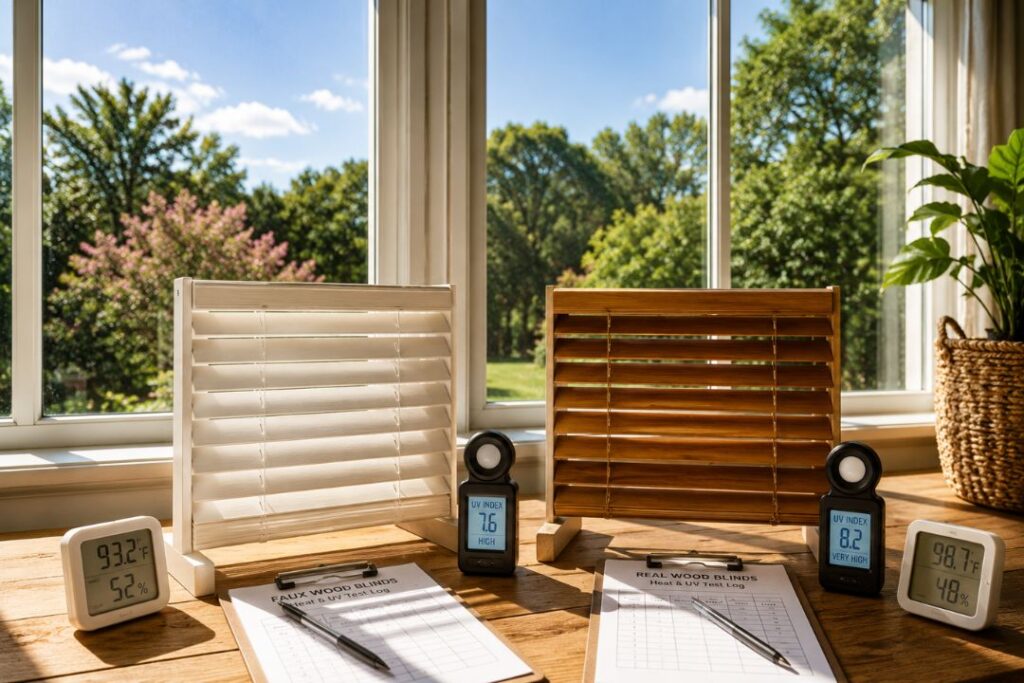
The Heat and UV Test: Sun Exposure Over a Full Summer
Direct sun does more than fade color. Over time, intense heat and UV exposure can dry out natural wood, leading to fine surface cracks and a dull, weathered finish that no amount of polishing can fully restore. West-facing windows in particular take a beating during a long Carolina summer.
Faux wood blinds are formulated to resist fading, yellowing, and heat-related warping even under sustained, direct sun exposure. That resilience makes them a strong pick for sun-exposed windows that face west or get direct afternoon light for hours at a stretch, day after day.
Round two verdict: Faux wood again proves more forgiving under prolonged heat and sunlight.
The Temperature Swing Test: AC Cycling and Daily Fluctuation
Here is a stress factor many homeowners never think about. Every time your air conditioning cycles on and off, the air near your windows shifts in temperature and humidity, sometimes several times a day. Real wood expands and contracts with those swings, and repeated cycles over a hot season can gradually loosen joints or slat mechanisms.
Faux wood is far more dimensionally stable across those daily shifts. It holds its shape whether the room is cool and dry from the AC or warm and humid before it kicks back on again, which keeps the blinds operating smoothly and quietly all summer long.
Round three verdict: Faux wood wins thanks to its consistent performance through temperature changes.
The Storm Season Test: Sudden Humidity Spikes
Summer storms roll through the Piedmont and Triangle regularly, and each one brings a sudden spike in indoor humidity, especially in rooms without great ventilation or a working exhaust fan. Real wood blinds near frequently opened windows or doors can react quickly to that surge, absorbing moisture faster than they can release it.
Faux wood blinds shrug off these sudden spikes without any noticeable change in performance. If your home tends to feel muggy after a storm rolls through, that steady resilience matters more than most homeowners expect until they experience it firsthand.
Round four verdict: Faux wood remains the steadier performer in unpredictable storm season conditions.
The One Category Where Real Wood Still Wins
None of this means real wood is a poor choice everywhere. In climate-controlled formal living rooms, primary bedrooms, or offices where humidity stays stable, real wood blinds deliver a natural grain, rich texture, and warm depth that composite materials still cannot fully replicate. If elegance is your top priority in a stable room, real wood earns its reputation and remains a beautiful long-term investment.
Where This Leaves You
For rooms exposed to real humidity, heat, and constant temperature shifts, faux wood blinds consistently outperform natural wood through a North Carolina summer. For dry, climate-controlled spaces where appearance matters most, real wood still holds its own beautifully. Many homeowners across the Triangle, the Piedmont, and Charlotte choose to mix both, placing faux wood in kitchens and bathrooms while reserving real wood for formal living spaces and bedrooms.
Frequently Asked Questions
Can real wood blinds be treated to resist humidity better?
Sealants and finishes can help slightly, but they do not eliminate moisture absorption. In consistently humid rooms, faux wood remains the more reliable long-term option.
Do faux wood blinds look as good as real wood?
Modern faux wood finishes closely mimic natural grain and color, and many homeowners cannot tell the difference from a normal viewing distance.
Is faux wood heavier than real wood blinds?
Yes, faux wood is generally a bit heavier, which is worth noting for very large windows that may need reinforced mounting hardware and brackets.
Which option is better for coastal or storm-prone areas?
Faux wood is the stronger overall choice for homes that experience frequent humidity spikes, since it resists moisture regardless of sudden weather changes.
Can I mix faux wood and real wood throughout my home?
Absolutely. Many homeowners use faux wood in humid rooms and real wood in climate-controlled spaces to balance durability and aesthetics.
The Real Test Is Your Own Home
Every home handles humidity a little differently depending on ventilation, sun exposure, and how often the AC runs throughout the day. If you are still weighing faux wood blinds vs real wood blinds for your own windows, the smartest next step is a professional in-home consultation where we can walk your specific rooms and recommend the material that will actually hold up through your next Carolina summer, storm season included.